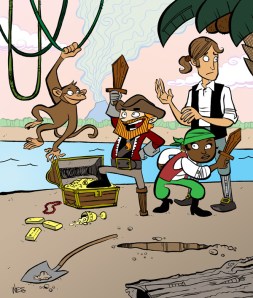
 Artist Wes Molebash is an illustrator and creator of cartoons.
Can you tell me more about yourself and your art?
I’m Wes Molebash and I draw cartoons. I’ve wanted to be a cartoonist for as long as I can remember, and I’ve been actively chasing this dream for over ten years, now. I live in southern Ohio with my wife, Kari, and our son, Parker.
My work is a blend of traditional and digital elements. I draw and ink most everything by hand, and then I scan the black-and-white art into Photoshop to apply color. I use a Wacom Cintiq 12WX when working digitally.
At what point in your life did you start thinking of yourself as an artist?
 When I was in 6th grade, some artists came to our school to discuss creativity and art with our class. I remember someone asked, “How do you know when you’re an artist?” and one of the presenters responded with, “You’re an artist when you say you’re an artist.”
I looked at my friend sitting next to me and said, “I’m an artist.” The artists must’ve overheard me, because one of them looked at me and said, “YEAH!”
So that was the moment.
How would you describe your spirituality?
I’m a Christian and my faith is very important to me. I hesitate to say I’m “devout” because I think that makes me sound more pious than I really am. But my faith is a huge influence in all areas of my life. 
How does your spirituality find expression in your art?
My faith has been expressed in different ways in my art. For the past ten years I’ve been drawing comic strips, and—for the most part—the cartoons were your typical slice-of-life fare; nothing overtly Christian about them. However, I just ended a comic strip that was commentary on the Christian subculture, so my faith wasn’t as subversive as it was in my previous work. I’m tilting back the other way with my current projects, though.
I believe that whatever your values are, they will be expressed in your work whether you want them to or not. Whether you’re a Christian or a Muslim or Hindu or atheist, that stuff is gonna come out in your work. Don’t force it. It’ll be better that way.
In all my work, I’ve never tried to evangelize. That’s never been a priority. Honesty is a priority. I wish it was more of a priority for other “Christian” artists. Maybe we wouldn’t have as much schlocky “Christian” art clogging up the marketplace.
Can you share a story of how creating your art expanded your awareness of God?
I don’t have a specific story, but I think that being an artist affects my faith in God. I’m a pretty abstract thinker and I have a wild imagination (as most creatives do), and I think that these traits make it easier for me to believe in God. I don’t think I have an unintelligent faith, but I do believe that my vivid imagination has caused me not to struggle with certain aspects of God that others might find unbelievable or even reprehensible.
How do you connect with divine flow when you are creating?
I don’t really experience a divine connection while I’m creating. I think a lot while I’m drawing. Sometimes I think about God. Sometimes I think about what we’re gonna have for dinner. Most of the time I’m thinking about the work.
How do you connect differently to your creative source when you work solo versus when you are collaborating with others?
 It’s definitely more fun and rewarding to work alone. Working alone means I’m working on one of my ideas, and I like my ideas the best.
How do ideas come to you?
Ideas come whenever they feel like it. The trick is learning how to harness them. Sometimes ideas come when you need to be focusing on other things, so you gotta learn how to hold on to an idea and mentally stick it in your back pocket until the appropriate times comes to work on it. I’m getting better at this, but I’m not great.
How do you decide which ideas to pursue?
I just “know.” I’ll be driving down the road and a fun idea will enter my brain and I can’t get rid of it. It starts rolling around in my head and becomes a huge distraction. I’ll write it down and—if I’m still excited about it a day or two later—then I know it’s got legs.
If you were going to teach your creative process to someone else, what would be one or two of the key things you would share?
NUMBER ONE: Listen to lots of great music; all different genres. So many stories can be developed by simply listening to a song. Music plays such a vital role in my ideation process. You gotta have good jams. It’s imperative.
NUMBER TWO: Do the work! Quit second-guessing yourself! Set a schedule and a timeline and get the work done! There will always be someone better than you! There will always be someone with more success than you! Don’t let that stop you!
How can our readers find our more about you and your work?
I blog at WesMolebash.com
I tweet at @THEWesMolebash
I’m on Facebook at facebook.com/THEWesMolebash
Thanks Wes!
With the Art as Worship radio show on hiatus, we’ll continue to feature artists using their written words to describe the connection between their art and their spirituality. Access the Art as Worship radio interviews on Empower Radio. Listen to an encore presentation of an artist’s interviews each Wednesday at 9am Eastern on Empower Radio. Like us on Facebook at Art as Worship, then share your art and comments. Contact Vanessa Lowry at vlowry (@) gmail.com if you would like to be a featured artist on Art as Worship. Namaste!

 Art As Worship